
World-class orthopedic surgery in China, same premium quality yet far more affordable than European & US treatments for your mobility.
The global orthopedic market continues its steady expansion, growing from approximately USD 47 billion in 2025 to an estimated USD 49.4 billion in 2026, with forecasts reaching USD 59.4 billion by 2030-1. Major trends reshaping the field include the rising adoption of minimally invasive procedures, increasing demand for joint replacement surgeries, and the integration of robotic-assisted surgery, artificial intelligence, and regenerative orthobiologics into clinical practice-1-. Yet amid this technological progress, a critical gap persists: post-operative rehabilitation. In many Western healthcare systems, patients are discharged within days of surgery, with limited inpatient rehabilitation coverage due to cost constraints and resource pressures. As a result, the full recovery potential of advanced surgical interventions often remains unrealized.
Quick Summary
In an era where global orthopedic care is advancing rapidly on the surgical front, China's integrated model addresses the often-neglected rehabilitation continuum with clinical rigor, cost efficiency, and environmental support. For international patients facing prolonged recovery trajectories, this combination represents a compelling and increasingly viable pathway to full functional restoration.
Key Facts
Medical Disclaimer
This content is for informational purposes only and is not medical advice. Patients should consult qualified healthcare professionals before using Traditional Chinese Medicine or any treatment for digestive symptoms.
Overview
China has responded to these challenges with a comprehensive, multi-tiered strategy. At the policy level, the National Health Commission and relevant authorities have issued guidelines on orthopedic disease prevention, minimally invasive surgery, and post-operative rehabilitation, setting quantified targets and outlining key actions covering early screening, standardized treatment, and rehabilitation capacity building. The approach emphasizes a life-course perspective, targeting adolescent scoliosis, sports injuries in young adults, degenerative joint disease in working-age adults, and osteoporosis and joint replacement needs in the elderly, with prevention and early intervention as the primary strategy. More recently, orthopedic rehabilitation has been integrated into broader national health frameworks, identifying bone and joint disease prevention as a core task.
China's approach is also characterized by technological innovation and grassroots implementation. AI-assisted imaging diagnosis, surgical robots, and 3D-printed personalized implants have been deployed in many hospitals to improve preoperative planning accuracy and shorten operative time. Enhanced Recovery After Surgery (ERAS) protocols and multidisciplinary team (MDT) care have been widely adopted, significantly reducing average length of stay and complication rates. Orthopedic rehabilitation capacity at community and county-level clinics is being strengthened through tiered diagnosis and treatment and standardized training. Cost-effectiveness analyses further confirm that early intervention and systematic rehabilitation yield substantial health benefits, reducing post-operative disability and readmission rates while generating net savings.
Disease Profiles
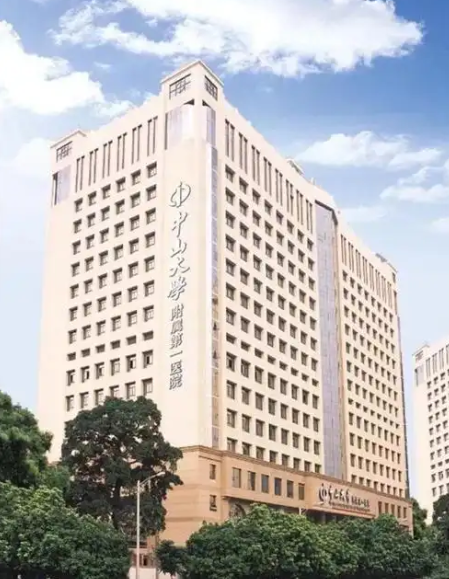
The Orthopedics Department of The First Affiliated Hospital of Sun Yat-sen University (Zhongshan First Hospital), as the leading orthopedics center in South China, ranked 9th nationwide in the 2024 Fudan Edition of the China Hospital Orthopedics Specialty Reputation Ranking. Its core strengths lie in comprehensive leadership across the three major fields of spine, joint, and trauma, and it has developed domestically top-tier technical characteristics in subspecialties such as bone tumors and microsurgery.
Spine Surgery: Precise Screw Placement and Correction of Severe Deformities
Spine surgery is a traditional strength of the Orthopedics Department of Zhongshan First Hospital, and Professor Li Fobao, the discipline leader, established its advanced domestic position. The department was among the first in China to carry out osteotomy and shortening techniques for severe spinal deformity with spinal cord deformity, and has unique research on precise pedicle screw placement, a core technique in spine surgery. It is particularly skilled in high-difficulty surgeries such as correction of scoliosis/kyphosis, cervical spondylosis, thoracolumbar spinal stenosis, and complete resection of spinal tumors. Professor Zheng Zhaomin, a key member of the discipline, has accumulated experience in more than 2,000 cases of scoliosis correction and minimally invasive spine surgery, featuring "lower cost, less trauma, and faster recovery."
Joint Surgery: Replacement, Revision, and Physiologic Reconstruction
Joint surgery has reached a level synchronized with advanced international technology in primary and revision hip and knee arthroplasty, and is particularly adept at managing complex joint conditions such as osteonecrosis of the femoral head, developmental dysplasia of the hip, and rheumatoid arthritis. Professor Sheng Puyi, director of the department, focuses on revision and reconstruction after failed joint replacement and the diagnosis and treatment of prosthesis infection, and was among the first in China to perform robot-assisted knee arthroplasty. The team has also pioneered a new surgical strategy of individualized physiologic reconstruction of the knee, as well as theoretical techniques for precise and limited quantitative placement of acetabular prostheses, significantly optimizing treatment outcomes for complex joint surgeries.
Bone Tumor Department: Highly Complex Limb Salvage and Pelvic Tumor Resection
The Bone Tumor Department is the most authoritative center for the diagnosis and treatment of bone and soft tissue tumors in South China and one of the national bone tumor centers. The department performs 800 to 900 bone tumor surgeries annually. The limb salvage rate for standardized treatment of malignant bone tumors exceeds 90%, and the number, difficulty, and treatment outcomes of surgeries are all among the top in the country. Professor Shen Jingnan, the discipline leader, serves as Chairman of the Sarcoma Committee of the Chinese Anti-Cancer Association. The department has reached domestically advanced levels in highly complex surgeries such as pelvic tumor resection and reconstruction, sacral tumor resection and reconstruction, and extendable limb salvage for malignant bone tumors in children.
Microsurgery, Trauma, and Hand Surgery: Historical Legacy and Peripheral Nerve Repair
Microsurgery, trauma, and hand surgery has a profound historical legacy. In 1964, it successfully performed the world's first replantation of a severed leg and founded the Chinese Journal of Microsurgery. This specialty is a National Key Clinical Specialty (Hand Surgery). It has achieved breakthrough results in peripheral nerve defect repair—the new decellularized allogeneic nerve repair material "Shenqiao," developed by Professor Liu Xiaolin's team, filled the gap in alternative materials for peripheral nerve defect repair in China. After use in patients with digital nerve defects, the excellent and good rate of monofilament tactile sensation at 6 months reached 94.44%, comparable to autologous nerve grafting. The department is also skilled in microsurgical repair of limb fractures and soft tissue trauma, limb function reconstruction, and correction of congenital hand deformities.
Cross-border Healthcare Insights
Guangdong has emerged as a compelling destination for orthopedic treatment and post-operative rehabilitation, combining world-class clinical capabilities with distinctive cost and recovery advantages.
The region is home to South China's leading orthopedic center — the First Affiliated Hospital of Sun Yat-sen University — which performs over 10,000 orthopedic surgeries annually and ranks among the top in China for complex procedures such as spinal deformity correction, joint revision, and pelvic tumor resection. Across Guangdong, hospitals have pioneered minimally invasive and enhanced recovery protocols. For example, calcaneal fracture surgery can now be performed within two days of injury without waiting for swelling to subside, cutting the rehabilitation period by two-thirds and significantly reducing hospitalization costs. Day surgery for total hip replacement has also been achieved, with patients discharged within 24 hours and walking five hours post-surgery.
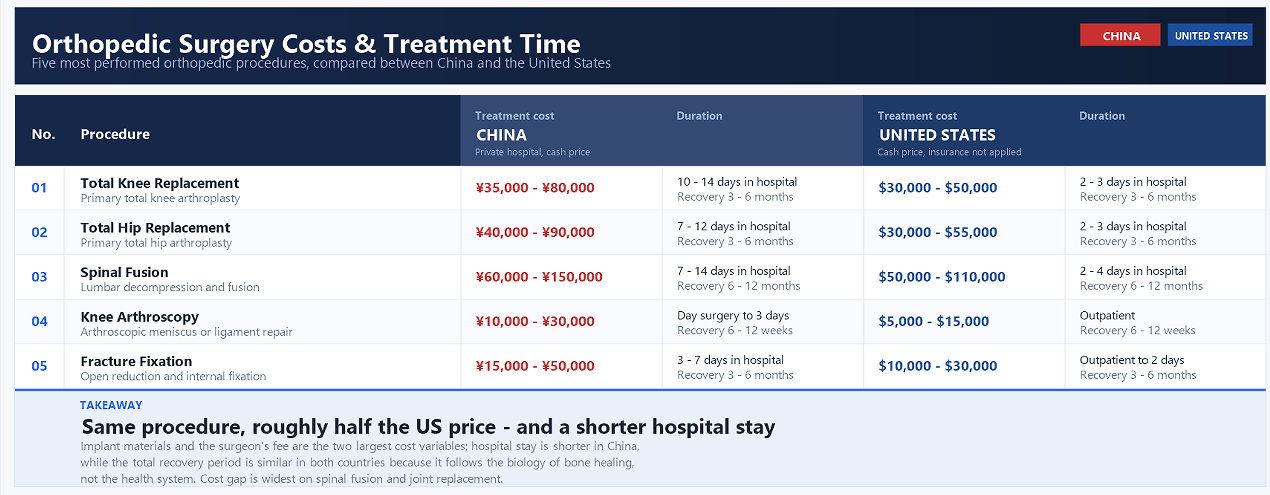
Cost efficiency is a major draw. National volume-based procurement has reduced knee surgery material costs by up to 90%, bringing the total out-of-pocket expense after insurance to approximately 10,000–15,000 yuan — a fraction of the tens of thousands of dollars charged in Western private hospitals. Hong Kong patients who cross the border for knee arthroplasty consistently experience shorter hospital stays and lower total costs than local patients in the region.
Beyond surgery, Guangdong offers a rehabilitation ecosystem that integrates Traditional Chinese Medicine with modern physiotherapy. Acupuncture, tuina, and herbal medicine are widely available alongside Western rehabilitation protocols, offering patients a more holistic recovery pathway. The subtropical climate further enhances this advantage. Xinxing County, repeatedly ranked among China's top wellness counties, features 68.38% forest coverage, unique sulfur-hydrogen hot springs, and a provincial-level wellness innovation center focused on rehabilitation therapy and medicated cuisine.
Looking ahead, China's orthopedic future is being shaped by ten innovation directions jointly issued by the National Orthopedics Medical Center in 2025, covering AI-assisted diagnosis, surgical robotics, personalized 3D-printed implants, regenerative medicine, and intelligent rehabilitation. Guangdong hospitals are already participating in this transformation through AI-guided surgical systems and remote 5G robotic procedures. These advances are expected to further shorten recovery timelines and improve outcomes, reinforcing Guangdong's position as an integrated hub for orthopedic care, rehabilitation, and wellness tourism.
Frequently Asked Questions
What symptoms were described in this patient experience?
The patient described long-term digestive discomfort, difficulty gaining weight, and diarrhea after meals.
What services were included in the TCM visit?
The visit included outpatient consultation, herbal medicine prescription, hospital decoction service, and home delivery of prepared herbal medicine.
How much did the visit cost?
The article mentioned around RMB 80 for consultation, herbal medicine, and decoction service, while one receipt showed RMB 95.14 for related outpatient charges. Actual costs can vary.
Does this article provide medical advice?
No. This article is an informational patient experience and should not be used as medical advice, diagnosis, or treatment recommendation.
Need help understanding your options?
SinovitaLink helps patients prepare medical information, understand care pathways, and navigate cross-border healthcare options.